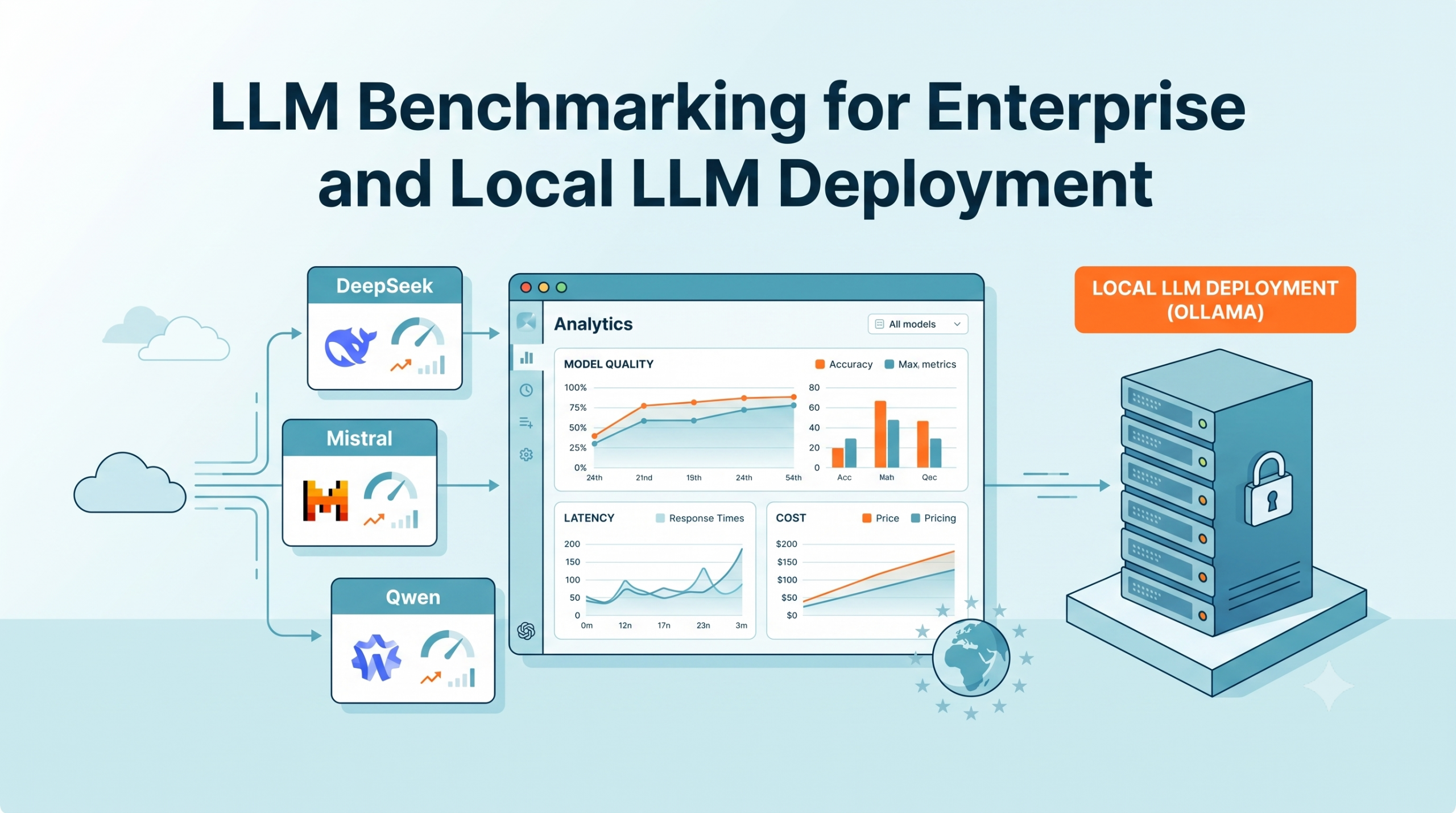
Large language model selection is no longer a simple question of which model sounds smartest in a demo. For enterprise teams, the real decision is which model performs best for a specific use case, deployment model, compliance requirement, language mix, and budget envelope.
That is why LLM benchmarking matters. CTOs, CIOs, product managers, and AI teams now need to evaluate models across reasoning quality, multilingual performance, latency, infrastructure cost, integration effort, privacy posture, and long-term maintainability. A model that ranks well on a public benchmark may still be the wrong choice for a regulated workflow, a private RAG deployment, or a multilingual enterprise assistant.
In this article, we compare three important model families—DeepSeek, Mistral, and Qwen—and also examine when local LLM deployment with Ollama makes sense. The goal is not only to describe the models, but to help CTOs, CIOs, product managers, and prospective clients evaluate them in a practical, business-focused way before production deployment.
The strongest model on a public leaderboard is not automatically the best model for a real enterprise workflow. Deployment, governance, language, privacy, infrastructure, and cost all matter.
Why LLM Performance Benchmarking Matters
The LLM market has moved from experimentation to real business use. Organizations now apply LLMs to customer support, internal knowledge assistants, code generation, cybersecurity analysis, document automation, translation, research, and decision support.
But comparing models only by public benchmark scores is not enough. A model can perform well on a leaderboard and still be a poor fit for a regulated workflow, a private RAG deployment, or a multilingual enterprise assistant.
A useful benchmark should measure reasoning quality, coding ability, multilingual performance, context handling, memory requirements, latency, deployment cost, privacy posture, local deployment options, and integration flexibility.
Enterprise teams should also assess governance factors such as data residency, access control, auditability, and support for secure AI integration. For example, the best model for a cybersecurity assistant may not be the best option for a French customer service bot or an Arabic-language knowledge assistant used across MENA and Europe.
DeepSeek: Strong Reasoning for Technical and Analytical Workloads

DeepSeek has become one of the most discussed open model families because it performs well in reasoning-heavy and technical tasks while still giving organizations more flexibility than fully closed models. It is especially relevant for coding assistants, technical documentation, mathematical problem solving, cybersecurity analysis, and agentic workflows.
For enterprises evaluating advanced AI assistants, DeepSeek is often attractive because it combines strong technical output with open deployment possibilities.
One of DeepSeek’s main strengths is that it gives organizations room to experiment, fine-tune, and deploy in more controlled environments. However, the main trade-off is infrastructure demand. Larger DeepSeek variants can require significant GPU memory, careful optimization, and a realistic understanding of latency under production load.
Smaller or distilled versions are easier to run locally, especially for proof-of-concept deployments, but they may not deliver the same quality as the full models in more demanding enterprise scenarios.
Best use cases for DeepSeek — DeepSeek is a strong option for:
- Advanced reasoning
- Coding assistants
- Technical documentation
- AI research
- Cybersecurity analysis
- Workflow automation
- Agentic AI systems
Mistral: European AI for Enterprise, Sovereignty, and Multilingual Deployment
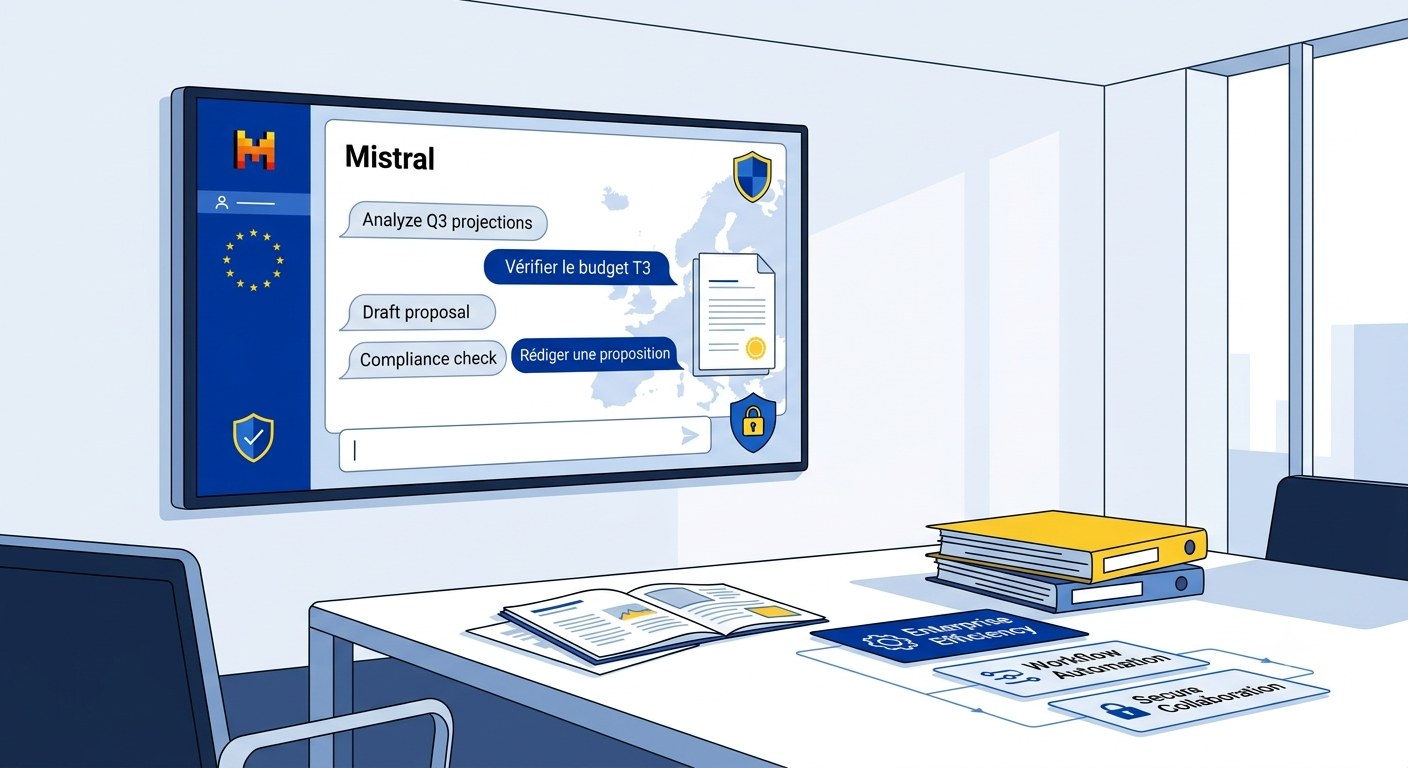
Mistral is one of the most important European AI companies and plays a visible role in the broader discussion around sovereign AI. It is especially relevant for organizations that care about multilingual support, enterprise deployment, privacy, and European regulatory alignment.
Mistral offers a range of models, from smaller efficient options to larger frontier, coding, and multimodal models, which makes it suitable for both lightweight applications and more advanced enterprise systems.
One of Mistral’s main advantages is its balance between performance, efficiency, and deployment flexibility. For many enterprise buyers, that balance matters more than achieving the highest score on a public leaderboard.
Mistral is particularly relevant for companies in Ireland and the wider EU that want high-quality multilingual AI while also paying attention to data sovereignty, governance, and secure AI integration.
Best use cases for Mistral — Mistral is a strong option for:
- European enterprise AI
- French and English workflows
- Multilingual assistants
- Document processing
- Coding assistants
- Internal copilots
- Private AI deployment
- Retrieval-augmented generation and enterprise AI integration
Qwen: Strong Multilingual Range and Long-Context Flexibility
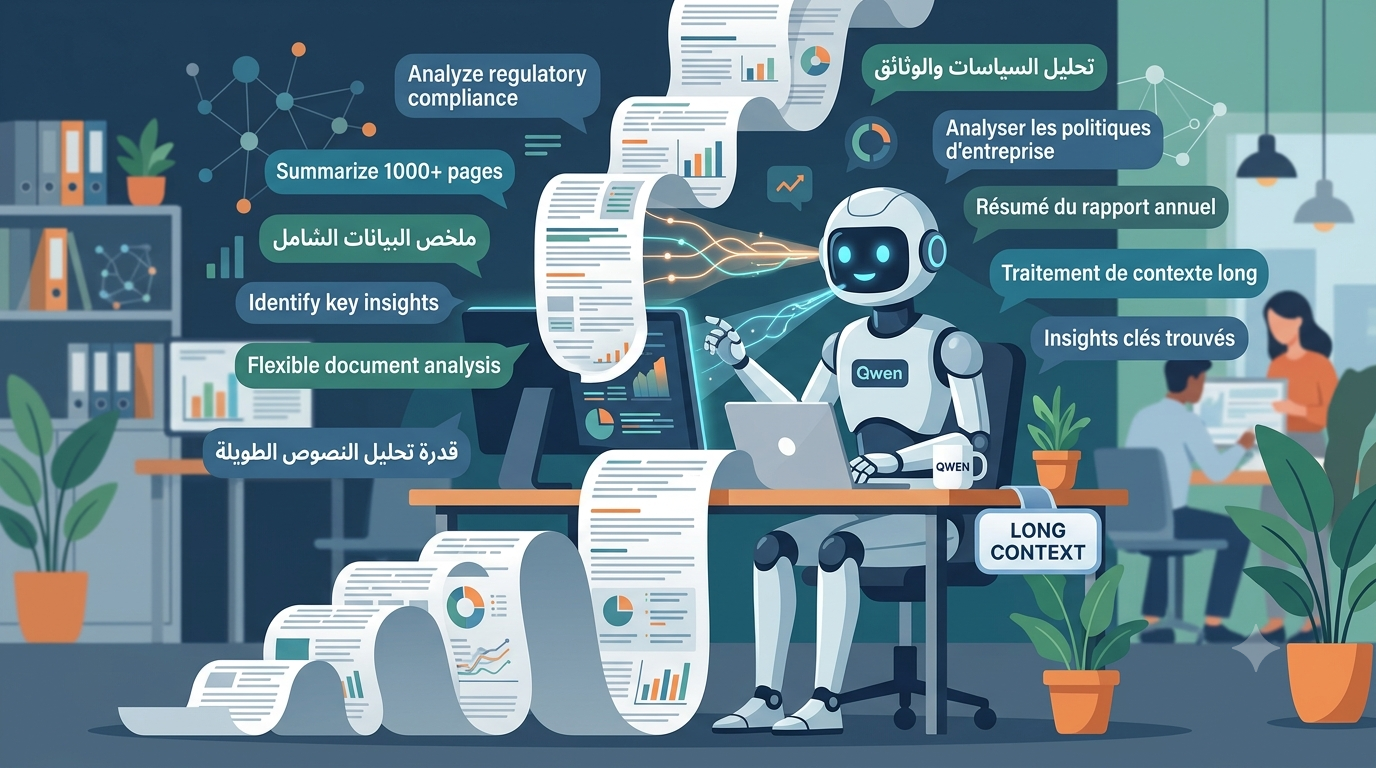
Qwen has become a strong model family in the open and commercial LLM ecosystem because of its multilingual capability, coding performance, long-context support, and suitability for agentic use cases.
Its range of model sizes makes it relevant for both cloud-based deployment and more constrained environments. Depending on the model version and configuration, Qwen can support document analysis, code generation, multilingual assistants, and AI agents.
Its main strength is versatility across technical, multilingual, and productivity-focused workloads. However, enterprise teams should still review licensing, deployment terms, memory requirements, ecosystem maturity, and supportability before adopting a specific version in production.
Best use cases for Qwen — Qwen is a strong option for:
- Multilingual applications
- Coding
- Document analysis
- Long-context tasks
- AI agents
- Cost-sensitive open model deployment
Ollama: Local LLM Deployment Framework for Privacy and Cost Control
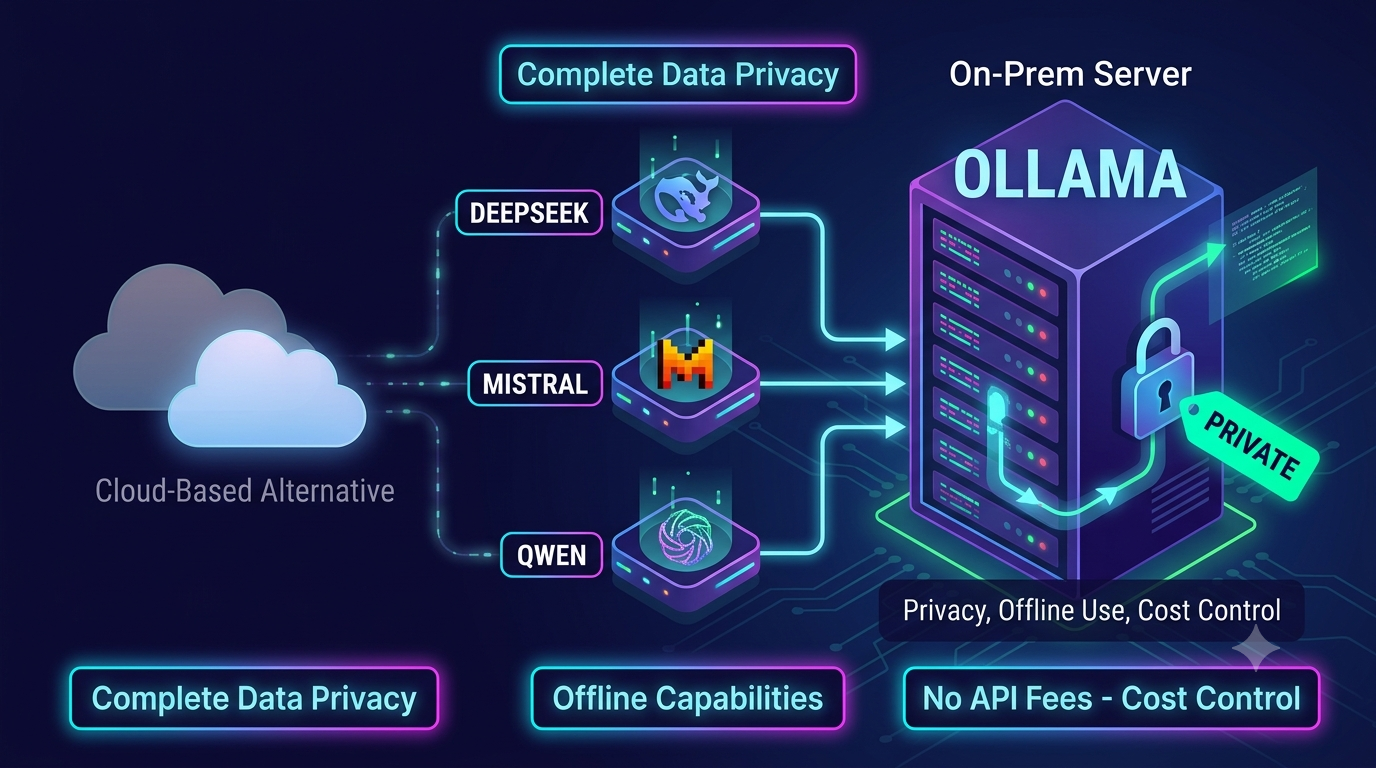
Ollama allows teams to run LLMs locally on their own infrastructure, which is especially relevant for organizations that do not want to send sensitive data to an external API.
Local deployment gives companies more control over privacy, cost, experimentation speed, and offline access. It is particularly useful for internal assistants, research prototypes, cybersecurity labs, private knowledge systems, and early-stage RAG deployments where tighter operational control matters.
However, local LLM performance depends heavily on hardware and deployment choices. The most important resource is usually GPU memory, or VRAM, although RAM, quantization strategy, and GPU offloading also shape real-world performance.
A model may be powerful on paper, but if the available hardware is undersized, the result may be slow inference, unstable context handling, or impractical throughput.
When evaluating local deployment through Ollama, organizations should measure model size, quantization format, RAM and VRAM requirements, context length, tokens per second, latency, GPU offloading behavior, and fit for the intended business use case.
In many local scenarios, smaller models in the 7B to 14B range are enough for prototypes and focused internal assistants, while larger models may offer better quality at a much higher infrastructure cost.
Best use cases for Ollama — Ollama is a strong option for:
- Local AI assistants
- Offline AI experimentation
- Internal knowledge bases
- Private RAG systems
- Cybersecurity labs
- Education
- Cost-controlled AI prototyping
Understanding Memory in LLM Benchmarking
Memory is one of the most important criteria in LLM evaluation, but it is often misunderstood because the term can refer to several very different technical realities. In enterprise benchmarking, memory usually refers to three distinct things.
A. Context Memory
Context memory refers to how much text the model can process in a single conversation or input. A larger context window helps the model analyze longer documents, codebases, logs, reports, or knowledge-base content. However, longer context is not always better. It increases memory demand and can raise latency, and some models become less accurate when the input includes too much irrelevant information.
B. Hardware Memory
Hardware memory refers to the RAM and VRAM needed to run the model in practice. Larger models require more memory, and quantization can reduce memory usage at the cost of some output quality in certain scenarios. A practical benchmark should record minimum RAM, minimum VRAM, quantization format, tokens per second, maximum stable context length, and whether the model runs fully on GPU or partly on CPU.
C. Long-Term Memory
Long-term memory is different from context length. Most LLMs do not permanently remember information unless they are connected to an external architecture. In business deployments, long-term memory usually requires a retrieval system, a vector database, user or session memory, access control, data retention rules, and privacy governance. This distinction is especially important for enterprise assistants, customer support bots, internal knowledge systems, and secure RAG architectures.
Comparative Overview of LLM Options
| Option | Main strengths | Main limitations | Best use cases | Local deployment |
|---|---|---|---|---|
| DeepSeek | Strong reasoning, coding, and open-weight flexibility | Large variants require significant infrastructure | Advanced reasoning, coding, technical AI agents | Possible with smaller or distilled variants |
| Mistral | European positioning, multilingual support, enterprise readiness, efficiency | Some advanced models may depend on API or enterprise deployment paths | European business AI, French/English workflows, private AI | Good for selected open models |
| Qwen | Strong multilingual range, coding, long-context support, agentic flexibility | Licensing and ecosystem support should be checked per version | Multilingual assistants, agents, document analysis | Good depending on model size |
| Ollama | Privacy, offline access, cost control, easy local testing | Limited by local hardware and memory | Prototyping, private assistants, RAG, education | Core local deployment framework |
Recommended Benchmark Methodology
To compare LLMs properly, organizations should create an internal benchmark based on real tasks rather than public leaderboard scores alone. A strong benchmark should include at least five categories and should reflect the actual workflows the business wants to support in production.
General Reasoning
Test the model on multi-step tasks, logical reasoning, planning, and decision support. Example tasks include explaining a technical problem, comparing business options, identifying contradictions in a report, and solving a structured reasoning problem.
Coding and Technical Tasks
Test the model’s ability to generate, debug, document, and explain code. Example tasks include generating Python scripts, debugging errors, explaining network security logs, producing SQL queries, and reviewing code quality.
Language and Localization
For multilingual organizations, test the model in the languages that matter to the business. This may include English, French, Arabic, and domain-specific vocabulary. Example tasks include summarizing a French document, translating business content, writing a professional email, and answering questions using local business context.
Long-Context and Memory
Test whether the model can use long documents without losing important information. Example tasks include summarizing a long report, answering questions from policy documents, comparing multiple documents, and extracting decisions from meeting notes.
Deployment Performance
Measure operational performance, not only output quality. Important metrics include latency, tokens per second, RAM and VRAM usage, cost per task, maximum stable context, error rate, privacy requirements, and compliance constraints.
Suggested Enterprise Benchmark Weighting
| Category | Weight | Sample evaluation criteria |
|---|---|---|
| Reasoning | 25% | Multi-step logic, factual consistency, summarization accuracy |
| Technical output | 20% | Code generation, debugging, documentation, log explanation |
| Multilingual quality | 15% | English, French, Arabic, terminology accuracy |
| Long-context handling | 15% | Long-document Q&A, report summarization, retrieval use |
| Deployment efficiency | 15% | Latency, VRAM, tokens per second, context stability |
| Governance and privacy | 10% | Data handling, auditability, access control, compliance fit |
Practical Recommendations
For most organizations, the best strategy is not to choose one model and use it for every task. A better approach is to build a model portfolio.
One practical strategy is to use a strong API model for complex reasoning and business-critical tasks, use Mistral or another European option for multilingual and sovereign AI use cases, use DeepSeek or Qwen for technical, coding, and open-model experimentation, and use Ollama for local testing, private prototypes, and sensitive data workflows.
This approach reduces dependency on a single provider and allows each use case to be matched with the most suitable combination of model quality, deployment method, privacy posture, and integration effort.
Conclusion
The LLM market is becoming more specialized, and different model families now serve different enterprise priorities. The real question is no longer which model is best in general, but which model is best for a specific task, language requirement, privacy constraint, infrastructure profile, and deployment environment.
For organizations, the strongest strategy is to evaluate models through practical benchmarking rather than hype alone. The best LLM is the one that delivers reliable performance under real business conditions and integrates cleanly into the workflows that matter most.